
TL;DR
Your runway keeps changing because the way cash actually moves through your business is different from how your model assumes it moves. Runway is calculated using cash and net burn, and both keep updating as real transactions happen.
The instability usually comes from a few core factors:
costs becoming layered and uneven
customer payments arriving later than expected
cash moving in cycles rather than evenly
data being delayed or spread across systems
Runway becomes reliable when you track actual cash inflows and outflows, separate revenue from cash timing, and update your numbers based on real activity instead of assumptions.
Runway keeps changing because real cash movement does not match the assumptions in your model.
Your runway looked comfortable last month. This month, it is tighter. You did not make a major hiring decision. Revenue has not dropped significantly. But the number still moved.
This is a common situation once a startup starts operating with real cash movement.
Data from CB Insights shows that running out of capital is the most common final outcome in startup failures, appearing in 70% of cases.
In many of these cases, the issue is not that founders ignore runway. It is that the number they rely on does not reflect how cash actually behaves.
What does runway actually measure?
Runway is the number of months your business can operate before cash runs out.
It is calculated as:
Runway = current cash ÷ net monthly cash burn (assuming current burn levels remain constant)
Net burn = operating cash outflows − operating cash inflows (excluding financing)
Runway does not change randomly, but it can appear unpredictable when underlying cash flow timing and burn levels are changing
SYSTEM INSIGHT / NEXT STEP
Make the next move with clarity.
If this issue is already showing up in reporting, runway, or team decisions, the next move is usually clearer with a structured finance view.
Why does runway feel unstable even when you track it?
Runway becomes harder to predict when your financial model assumes clean behaviour but your business operates with delays, uneven costs, and incomplete data.
Early on, a simple formula works. As the business grows:
costs stop being flat
collections stop being predictable
timing stops being even
The structure of the model stays the same. The inputs stop behaving that way.
Where runway actually breaks in practice?
1. Burn is no longer a fixed number
Your burn changes because your cost structure becomes layered.
What starts as salaries and a few tools expands into:
employer taxes
SaaS subscriptions
variable spend (ads, contractors)
one-off costs (annual tools, hiring, legal)
This creates uneven monthly outflows. Some months carry more weight than others, which directly impacts the runway.
2. Revenue does not equal cash
This difference comes from accrual accounting, where revenue is recorded when earned.
Runway depends on cash in the bank. You may record revenue in a given month but receive the cash later. That delay reduces your available runway.
This creates a gap between:
what the business earns
what the business can actually spend
3. Timing becomes uneven
Cash movement happens in cycles, not evenly across months.
In practice:
expenses cluster together
collections arrive late or in batches
This creates visible fluctuations in runway, even when overall performance is stable.
4. Your data is slightly behind
Runway changes because your numbers are not current.
If reporting is updated monthly, your runway reflects a past position. By the time you review it, new transactions have already changed the outcome.
5. Your finance setup is fragmented
Runway becomes unreliable when your data is split across tools.
In most setups:
billing shows revenue
accounting shows recognised income
bank shows actual cash
These do not align in real time.
Result:
multiple runway numbers
manual reconciliation
low confidence in decisions
Model vs reality: why runway keeps shifting
Area | Model Assumption | Actual Behaviour | Impact on Runway |
Burn | Fixed monthly | Variable and layered | Faster cash usage |
Cash | Immediate inflow | Delayed collections | Shorter runway |
Timing | Even distribution | Lumpy cycles | Month-to-month changes |
Data | Always current | Lagging | Late adjustments |
System | Single source | Fragmented tools | Inconsistent numbers |
What actually stabilises runway
Runway becomes more predictable and explainable when cash, burn, and timing are tracked in one structured finance stack.
This does not require changing the core formula, but it does require better inputs and, in some cases, more detailed forecasting.
In practice:
track net cash burn (not partial costs)
separate revenue from cash collection
update numbers based on actuals, not assumptions
ensure all tools feed into one consistent structure
Once this is in place, changes in runway become easier to explain and rely on for decisions, even though the number will continue to update over time.
What should you do this month to stabilize the runway?
The runway becomes more reliable and consistent when you fix inputs in a specific order.
Start with these steps:
1. Recalculate burn using cash, not assumptions
Pull your last 60–90 days of bank transactions and calculate actual cash outflow, adjusting for one-off or annual payments to avoid distortions, including salaries, tools, taxes, and one-off costs.
2. Map actual cash inflows
Check when customers actually paid, not when revenue was recorded. Identify delays in collections.
3. Build a simple cash timeline
List expected inflows and outflows for the next 60–90 days to identify timing gaps.
4. Compare model vs actuals
Find where assumptions break:
costs higher than expected
collections slower than planned
uneven timing
5. Update runway using real inputs
Recalculate runway based on corrected burn rate and actual cash movement.
What changes after this
Once these inputs are aligned:
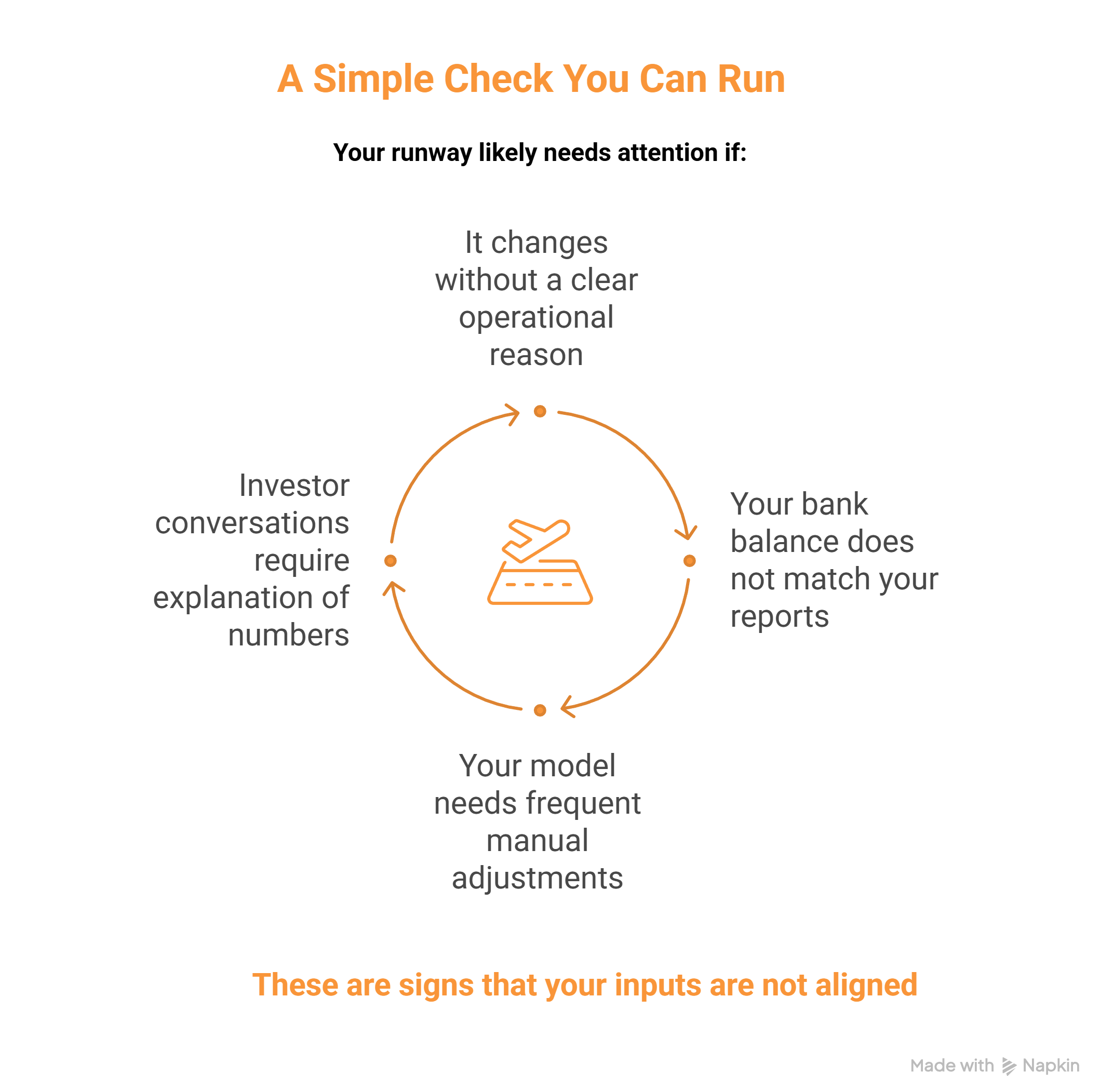
runway stops shifting without explanation
your bank balance aligns with your model
decisions become faster and clearer
investor conversations require less justification
What this means for founders
This issue appears when revenue starts growing, hiring increases, and decisions depend on financial visibility.
At this stage, spreadsheets become harder to maintain reliably as complexity increases. The business moves faster than the system supporting it.
See exactly where your finance system is breaking
If your runway keeps changing every month, adjusting the model will not solve it.
What you need is a setup where:
cash inflows and outflows are tracked in real time
billing, accounting, and payroll feed into one structure
runway updates automatically as inputs change
At Accountup, this is built as a working finance engine designed for startups at this stage.
If you want to understand how your runway should behave based on your actual operations, start with a simple assessment and identify where your current setup is misaligned.


