
Accounting for Startups: A UK Founder's Guide (Pre-Seed to Series A)
Most startup accounting advice is the same article with a different logo. "Get your books in order. Use cloud software. Track burn rate." Fine. True. Useless.
This guide is about the decisions that actually cost UK founders money — not in theory, but in specific, recoverable ways. R&D tax relief most startups under-claim. VAT schemes that pay you to be on the wrong one. Revenue recognition errors that create a 6-figure gap between what you think you're worth and what your Series A term sheet says.
The consensus advice is correct. It just isn't where the money is.
The £40,000 mistake most UK tech founders make
R&D tax relief is the most under-claimed benefit available to UK startups. HMRC's scheme exists specifically to return cash to companies building new technology — but most founders either don't claim it, claim too little, or claim it wrong.
Here's the rough maths for a loss-making SME under the current merged scheme (accounting periods beginning on or after 1 April 2024):
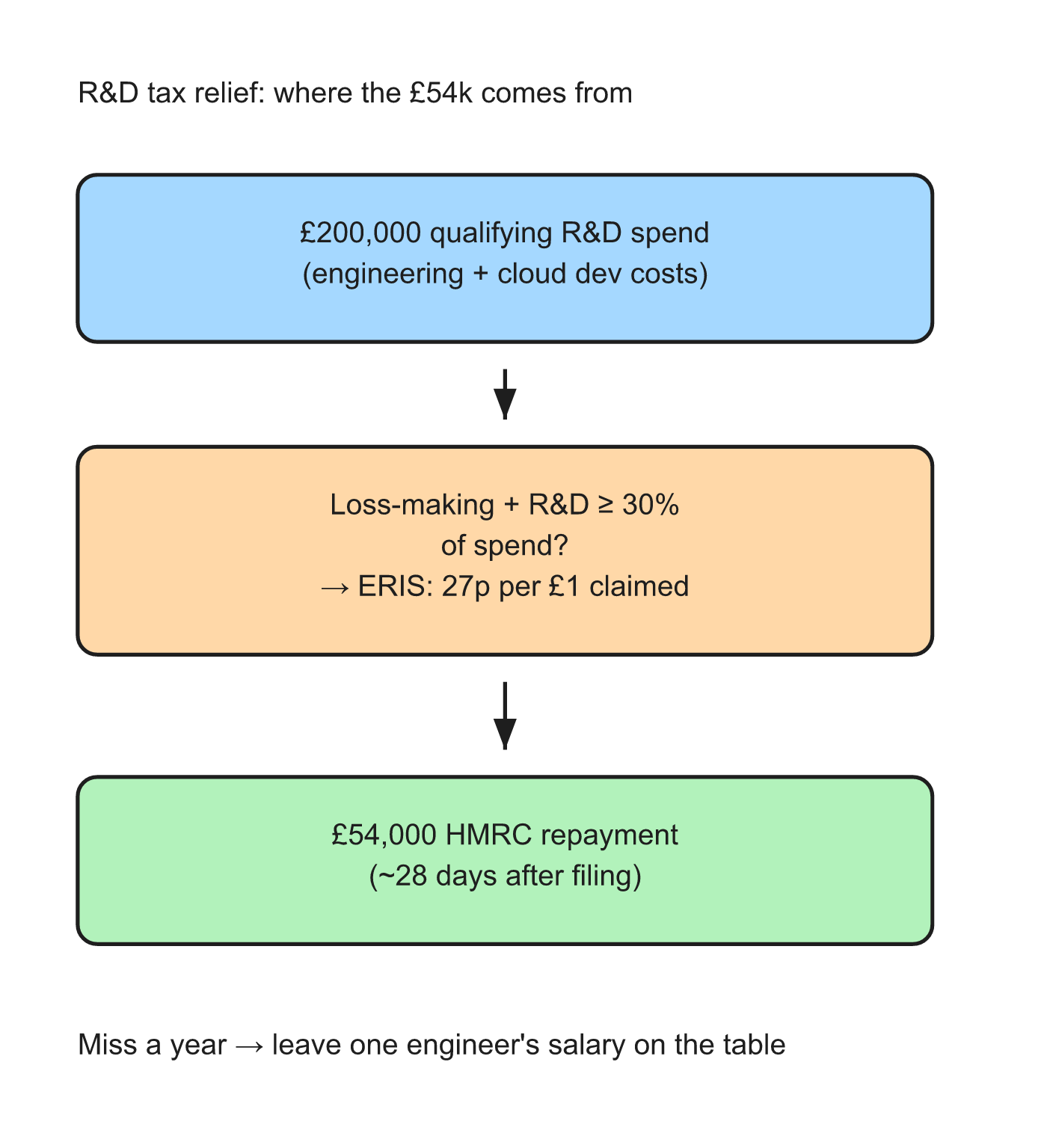
You spend £200,000 on qualifying R&D in a year — primarily engineering salaries, subcontractor costs on the technical work, and some cloud infrastructure directly used for development. Under the enhanced R&D intensive support (ERIS) scheme, available to loss-making companies where R&D makes up at least 30% of total expenditure, HMRC will pay a repayable tax credit of 27p for every £1 of qualifying spend. On £200k, that's £54,000 back in your bank account from HMRC within roughly 28 days of filing.
Miss one year at that spend level and you've left £54,000 on the table. Miss two, and you've given HMRC a free loan the size of a decent engineer's salary.
What most founders get wrong:
The most common failure isn't not claiming — it's claiming too narrowly. Founders assume R&D means pure research. HMRC's definition is broader: work that seeks to advance science or technology by resolving a scientific or technological uncertainty. Writing novel ML inference code, building an integration where the approach wasn't known upfront, solving a performance problem that existing tools couldn't handle — these qualify. Routine software development doesn't.
The second failure is record-keeping. HMRC increasingly scrutinises claims. You need contemporaneous evidence: which engineers worked on which projects, what uncertainty they were resolving, and how long they spent on it. This is not something you reconstruct at year-end. It needs to live in your project management tool or time-tracking system, mapped against your Xero chart of accounts from day one.
A well-documented claim from a £1m seed-stage team spending 60% of payroll on product can realistically return £60,000–£90,000 annually. That's not a rounding error.
SYSTEM INSIGHT / NEXT STEP
Make the next move with clarity.
If this issue is already showing up in reporting, runway, or team decisions, the next move is usually clearer with a structured finance view.
The VAT decision that quietly costs service businesses
You register for VAT when you hit £90,000 rolling 12-month turnover (or earlier, voluntarily). Most founders register on the Standard Rate scheme without realising there's a choice — and for many early-stage service businesses, that's the more expensive one.
The Flat Rate Scheme works like this: instead of accounting for the difference between VAT you've collected and VAT you've paid on inputs, you pay a fixed percentage of your gross (VAT-inclusive) turnover to HMRC and keep the rest. The rate depends on your business type.
For a SaaS or tech consultancy business with few VAT-able inputs, the maths often favours Flat Rate. Here's a worked example:
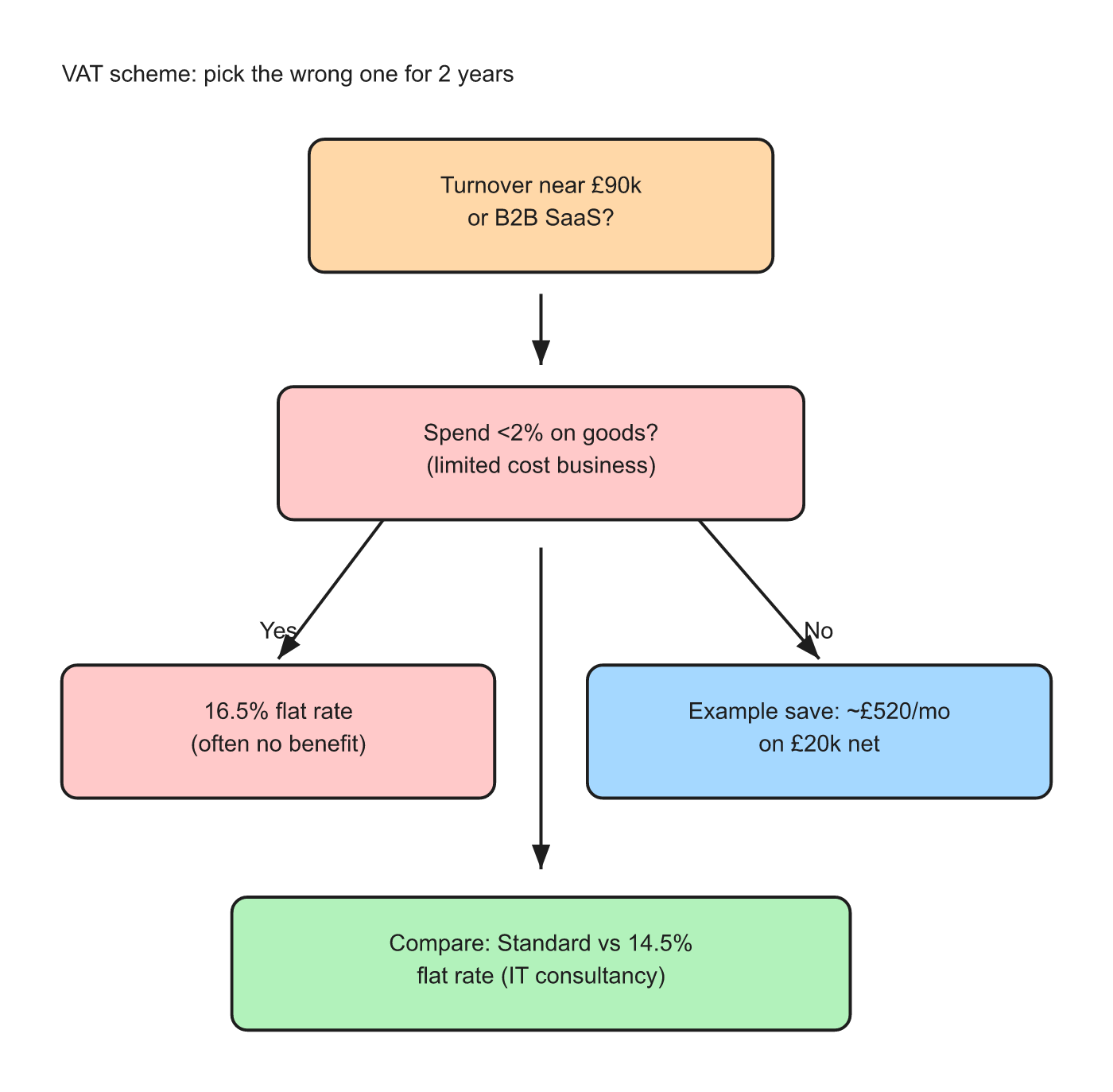
A startup invoices £20,000 net per month (£24,000 inc. VAT at 20%). On Standard Rate, they'd owe HMRC £4,000 minus input VAT on purchases — say £200 — so £3,800 per month to HMRC.
On Flat Rate at 14.5% (computer and IT consultancy) applied to gross: 14.5% × £24,000 = £3,480. The startup keeps the £520 difference. Over a year that's £6,240 that stays in the business.
There's a catch: if you're a "limited cost business" — roughly, if you spend less than 2% of your turnover on goods — HMRC charges you 16.5% flat rate, which often eliminates the benefit. Most pure SaaS businesses fall into this category. The calculation is quick; getting it wrong for two years isn't.
The other decision that matters: cash vs accrual basis for VAT. On cash accounting, you only pay VAT when your customer pays you. If you invoice net 30 or net 60, that's a meaningful cash flow difference in early growth when your receivables are high and your bank balance is under pressure.
Why accrual accounting isn't optional for SaaS founders
There's a version of this section in every startup accounting guide: "cash accounting is simpler but accrual is more accurate for growing companies." That's technically correct and practically useless. Here's what it actually means for a SaaS startup.
You close your best month ever. You invoice three enterprise clients for annual contracts — £120,000 total, all paid upfront in January. On cash accounting, your January P&L shows £120,000 in revenue. February through December show near-zero software revenue. Your "profitable January" is an artefact of the billing cycle, not the business.
Now you take that to a Series A investor. They're looking at trailing 12-month revenue growth. January's spike makes your growth rate look erratic. The MRR trend — the number they actually care about — doesn't show up at all.
On accrual, each of those annual contracts gets recognised at £10,000/month over the contract period. Your January shows £10,000 in new ARR added, which matches the commercial reality. Your revenue line is now comparable to every other SaaS company raising at Series A.
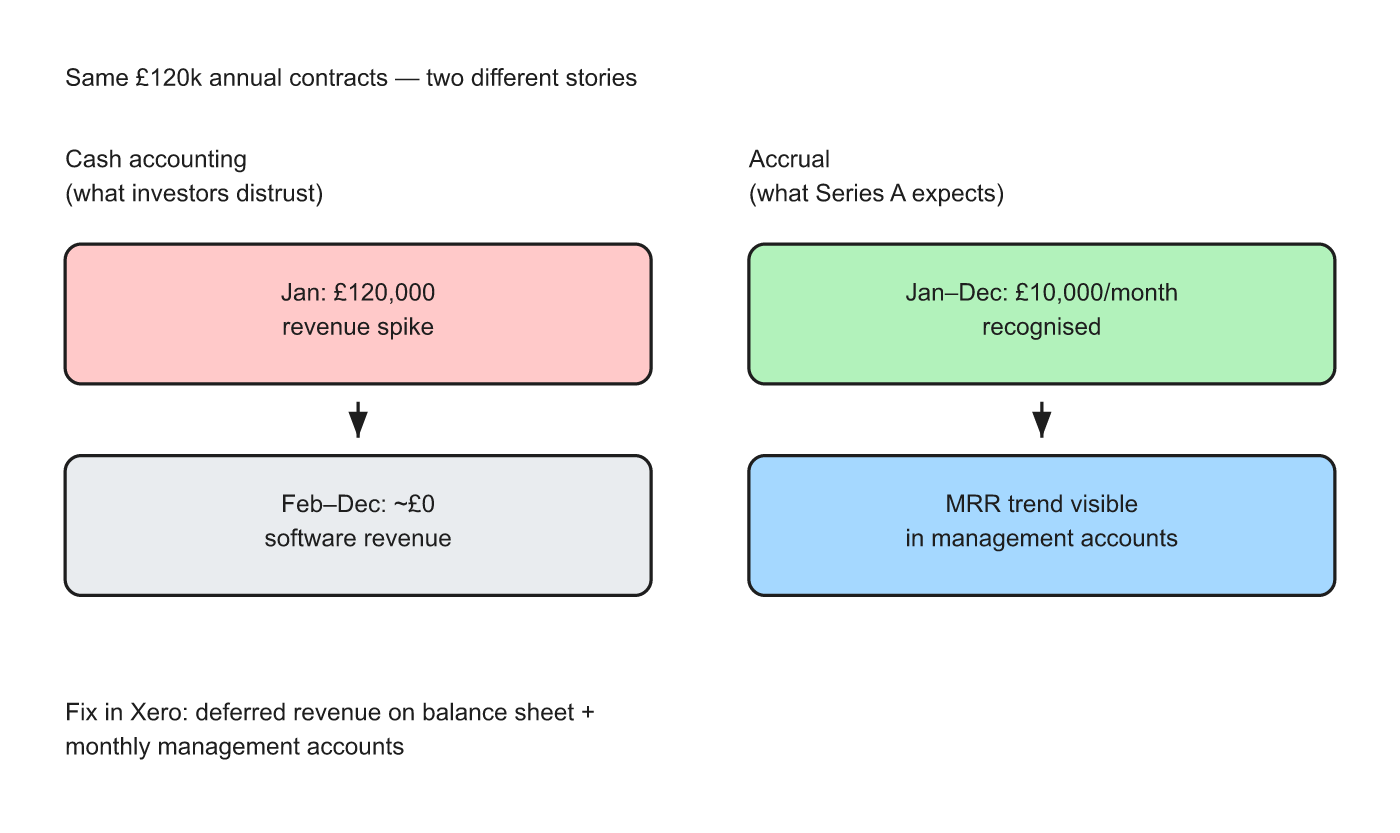
The practical test: if your revenue recognition policy wouldn't survive a 30-minute conversation with a VC's finance director, fix it before you raise. The fix involves setting up deferred revenue on your balance sheet in Xero — tracking what you've billed but not yet earned — and running management accounts on that basis, even if your statutory accounts use a different treatment.
What you actually need at each stage (and what can wait)
Pre-seed — the one thing that matters
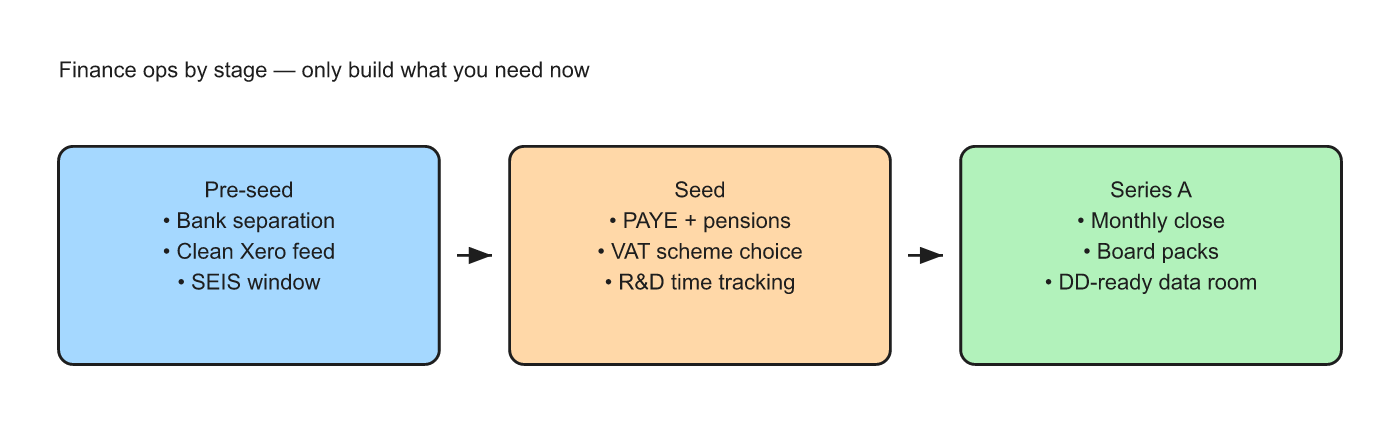
You need one thing: separation. Business money in a business account. Personal money stays personal. Director loans — money you've put in or taken out — tracked explicitly.
Everything else is optional. You don't need a complex chart of accounts. You don't need monthly management accounts. You don't need a finance partner yet.
What you do need is for your Xero (or equivalent) to be set up properly when you do bring someone in. A clean bank feed from day one takes ten minutes. Untangling 18 months of mixed transactions before an investor data room takes weeks.
The SEIS decision matters here too. If you're raising from angels, the Seed Enterprise Investment Scheme gives investors 50% income tax relief on up to £200,000 invested in your company. To qualify, you need to meet specific conditions — including that your company is less than 3 years old at the point of investment and has fewer than 25 employees. Miss the window or fail the conditions and your angels lose their tax relief. That's often a fundraising conversation, not just an accounting one.
Seed — three things that will hurt if you get them wrong
First: payroll. The moment you put someone (including yourself) on PAYE, you're in a compliance regime with real teeth. PAYE submissions are due monthly. Pension auto-enrolment kicks in automatically once employees hit the earnings threshold. Fail to set it up and The Pensions Regulator issues penalty notices that start at £400/day for non-compliance. The setup takes an afternoon with a payroll provider. The cleanup, if you miss it, takes months.
Second: VAT registration timing. Most founders register reactively — when they cross the threshold or when their accountant notices. The better move is to model forward. If you expect to cross £90k in the next 6 months, register now, reclaim input VAT on pre-registration purchases (you can reclaim on goods bought in the past 4 years and services in the past 6 months if you still have them), and get the scheme decision right from the start rather than switching later.
Third: R&D record-keeping starts now. Not when you decide to make a claim. If you have engineers writing novel code, structure your Xero chart of accounts to capture R&D staff costs and subcontractor spend separately from day one. Set up your project tracking so you can pull a time allocation report against technical projects. When you claim for the first time, probably at year-end, those records are what stand between you and an HMRC enquiry.
Series A — the thing that br
eaks in due diligence
The most common Series A finance failure isn't the numbers being wrong. It's the numbers being unverifiable. The investor's finance team asks for monthly management accounts going back 24 months, a cap table with a clean audit trail, deferred revenue reconciled to contracts, and payroll records. You have most of this — in different places, in different formats, assembled by different people over two years.
The solution isn't hiring a CFO two weeks before closing (though founders try). It's building a month-end close process — consistent, documented, owned by one person — that produces the same format of management accounts every month. By the time due diligence comes, you're handing over a folder with 24 months of identical-format reporting. That's what "investor-ready" actually means.
The companies that go through Series A the fastest have one thing in common: their finance data tells a coherent story with no unexplained gaps. The companies that slow down — or lose momentum entirely — are the ones who spend three weeks of a live process reconstructing what happened 18 months ago.
EMI schemes: the hire that costs you nothing and competitors rarely do
Enterprise Management Incentives are HMRC-approved share option schemes for early-stage UK companies. They're worth understanding because the tax treatment is dramatically better than unapproved options — and most UK startups can use them.
Under an EMI scheme, employees pay income tax only on the difference between the market value at grant and the exercise price — and only when they exercise and sell. If you grant options at market value, there's no income tax at grant or exercise. Employees pay capital gains tax (currently 18% or 24% depending on rate) when they sell, rather than income tax at up to 45%.
For a seed-stage engineer choosing between your offer and a larger company's, an EMI option over 1% of the company — granted at today's low valuation — can be worth significantly more than a salary premium, if the company grows. And it costs the company nothing in cash.
What catches founders out: the company valuation needs to be agreed with HMRC before you grant options, using an approved methodology. The valuation is typically low at early stages, which is exactly when you want it — that's the point. Waiting until Series A when your valuation has been set by external investors means the strike price is higher and the employee's tax-efficient gain is smaller.
What "messy books" actually costs when you raise
This is the number most founders don't see until they're in it.
You're in a live process. An investor issues a term sheet. You have 6–8 weeks to close. Their finance team sends the data room request. It's long: 24 months of management accounts, VAT returns, payroll records, PAYE submissions, contracts, cap table history, deferred revenue reconciliation.
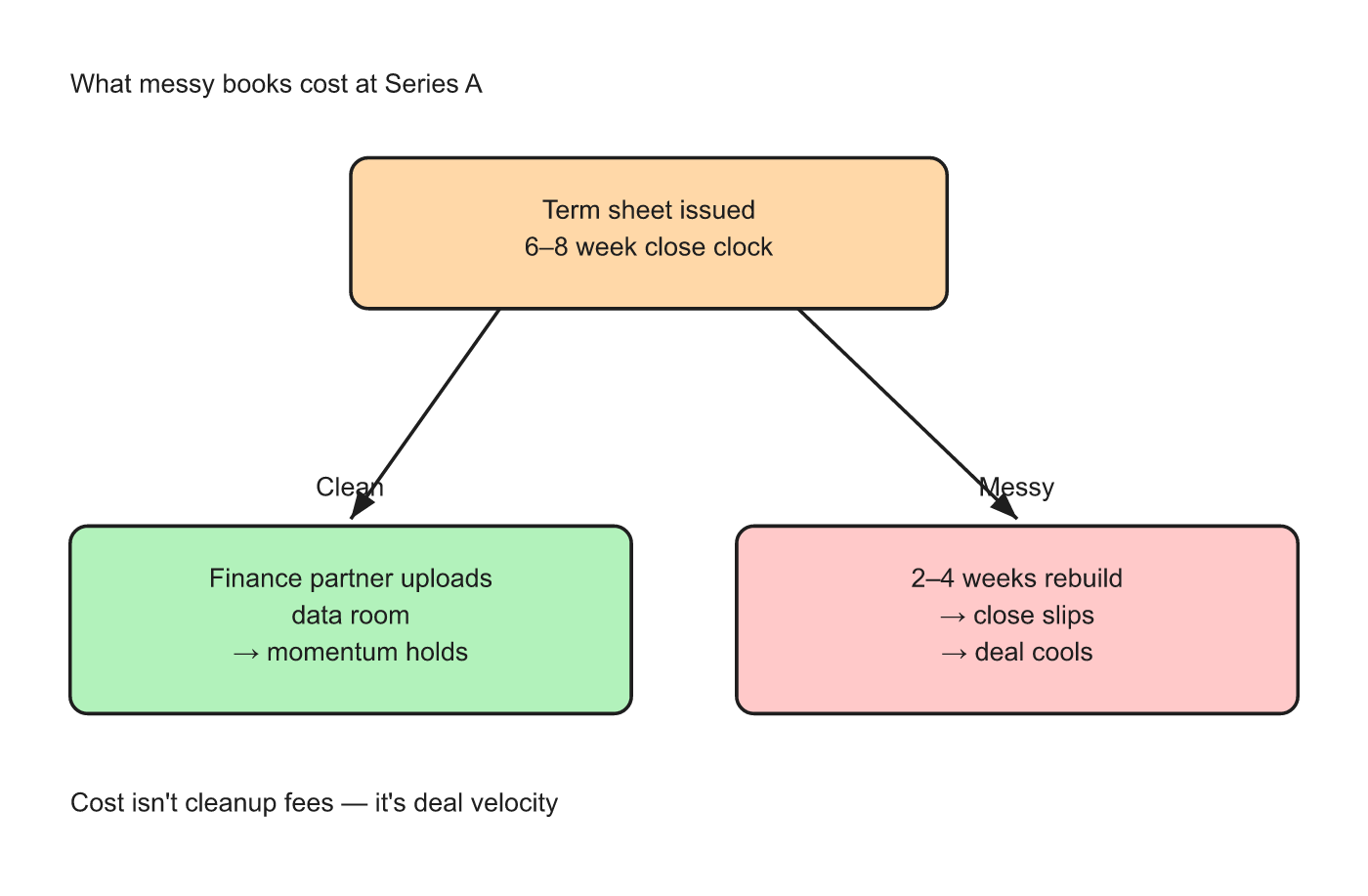
If your books are clean, your finance partner uploads a folder. Process continues.
If your books need reconstructing, here's what actually happens: your accountant or you spend 2–4 weeks pulling this together. Investor perception shifts — not necessarily dealbreakingly, but visibly. Other term sheets you're holding get stale as your close date slips. The lead investor's momentum — which is real and fragile — cools. In some cases, the deal reprices. In others, it dies.
The cost of messy books at Series A isn't the accountant's fees to clean them up. It's deal velocity. Investors close fast when conviction is high and everything is verifiable. They slow down or walk when they can't verify.
Clean books are a fundraising asset, not a compliance task.
The Accountup approach
We're not a compliance-first accounting firm. We work with funded UK and international tech startups — SaaS, AI, fintech — from the moment finance starts to break under growth.
What that looks like in practice: your Xero is the single source of financial truth. Bank feeds, Stripe, payroll, and expenses all connect cleanly. Monthly management accounts land within 10 business days of month-end, in the same format every time. Burn and runway are visible without a call. When you go to raise, we put together the data room pack. When you hire, we model the cash impact before you sign.
We run on Xero. Not because it's the only good accounting software, but because we've built our processes around it and we know exactly what it can do for a scaleup. If you're on something else, we'll talk about migrating. If you're not set up at all, we'll build it properly from day one.
The founders we work best with are at the stage where "I'll handle finance later" has clearly stopped working. They've raised, they're hiring, and the books are somewhere between messy and alarming. That's a tractable problem — most startups at seed with good business fundamentals can be in clean shape within 60 days.
If that sounds like where you are, talk to us.
The five questions a funded founder should be able to answer without opening a spreadsheet
What is our current runway at current burn?
What does our gross margin look like this quarter vs last?
Are we behind or ahead of our VAT position this period?
Have we filed our R&D claim for last financial year?
What would our management accounts show a new investor right now?
If any of those require a day's work to answer, the accounting infrastructure needs attention. Not urgently in a "the business is at risk" way — but urgently in a "every month this takes longer and every investor conversation is slower than it should be" way.
Good finance operations aren't a cost centre. They're the system that tells you whether the bets you're making are working.


