
Financial reporting for startups: what investors actually read
Founders often send investors a 40-tab spreadsheet and call it reporting. Investors do not read 40 tabs. They read five things in a fixed order, then decide whether to ask for more.
Financial reporting for startups is not year-end compliance. It is how you prove capital is deployed wisely between raises.
What is financial reporting for startups?
Financial reporting for startups is the regular presentation of financial statements and KPIs (usually monthly) so founders, boards, and investors can judge performance, runway, and risk.
For UK limited companies, this sits on top of statutory accounts and HMRC filings. Investors care about the operating view, not your Companies House filing format.
What investors read first
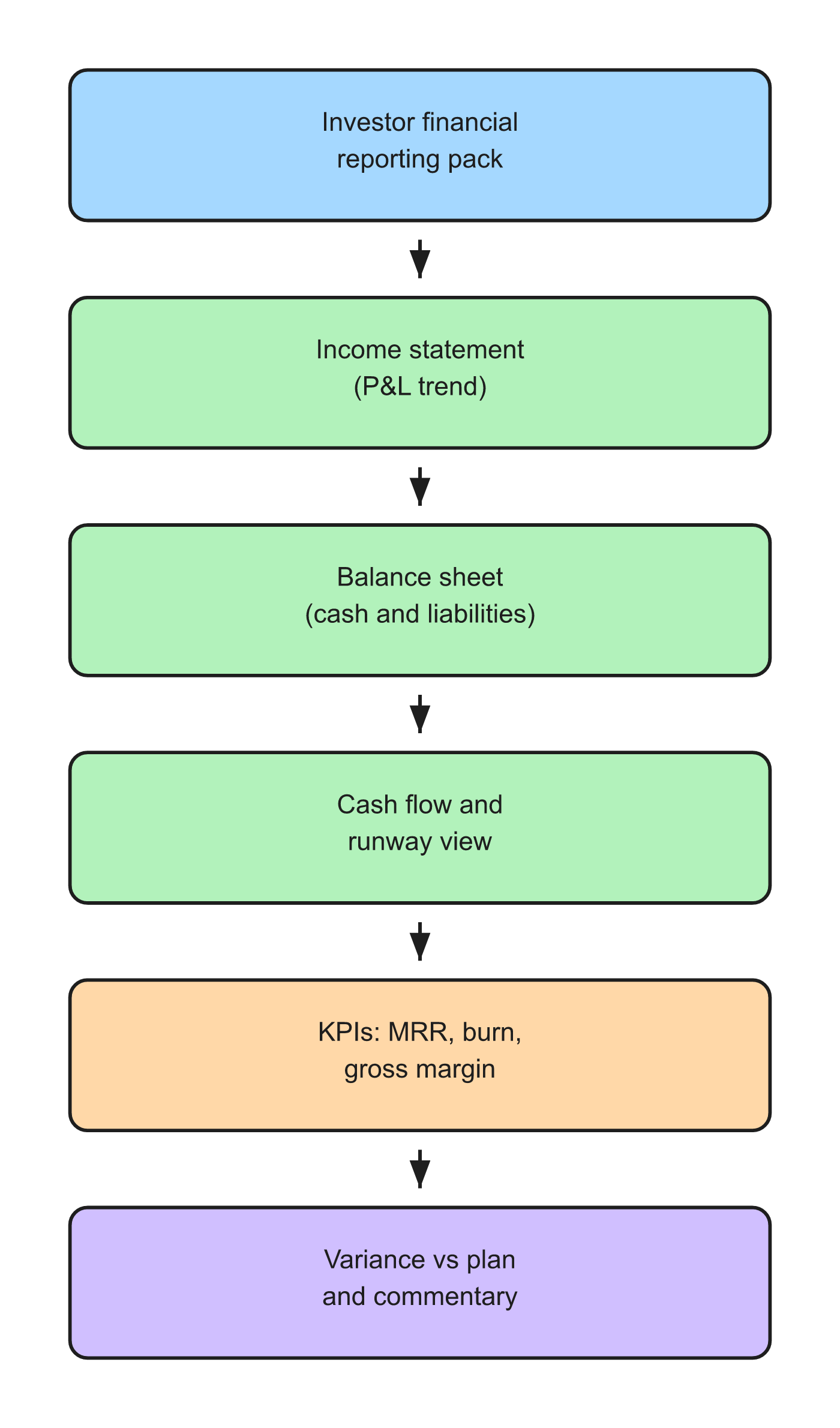
US investor education typically emphasises P&L, balance sheet, and cash flow. UK VCs often add runway, burn, and cohort metrics in the first pass.
SYSTEM INSIGHT / NEXT STEP
Make the next move with clarity.
If this issue is already showing up in reporting, runway, or team decisions, the next move is usually clearer with a structured finance view.
1. Income statement (P&L trend)
Investors scan:
Revenue growth month on month and year to date
Gross margin (if applicable)
Operating spend by category (people, S&M, R&D)
Net burn implied by P&L vs cash
They compare to what you pitched in the deck. Material misses need explanation in commentary.
2. Balance sheet (cash and obligations)
Snapshot questions investors ask:
Cash and equivalents (does it match bank?)
Debt or convertible instruments
Debtors and deferred revenue (SaaS)
Creditors and accruals
A strong P&L with a weak balance sheet (ballooning debtors, missing accruals) signals reporting risk.
3. Cash flow and runway
Cash truth beats accounting profit at seed and Series A.
Metric | Why investors care |
Monthly burn | Pace of capital consumption |
Runway (months) | Time to milestone or raise |
Net cash movement | Reconciles P&L to bank |
This is often the first page after the headline numbers.
4. KPIs (stage-appropriate)
Do not send every metric you track. Send what your board already uses:
Stage | Examples |
Seed | MRR, customers, burn, runway, headcount |
Series A | NRR, gross margin, CAC payback, sales efficiency |
Align KPIs with your management accounts pack.
5. Variance vs plan and commentary
Investors read commentary last but remember it longest. Answer:
What beat plan and why?
What missed plan and why?
What changed about runway or strategy?
What do you need from the board?
One page maximum. No jargon.
Financial reporting vs other finance outputs
Output | Audience | Frequency |
Investor/board reporting | Investors, board | Monthly |
Management accounts | Leadership | Monthly |
Statutory accounts | Companies House, HMRC | Annual |
CT600 | HMRC | Annual |
Good startups use one data source (Xero) feeding management accounts and investor packs. Rebuilding for each audience creates errors.
In practice
Operational finance (bookkeeping, month-end close, management accounts) produces the numbers. Investor reporting is the presentation layer on the same data.
That means diligence numbers match board numbers, and founders stop maintaining parallel spreadsheets.
FAQs
What financial reports do startup investors want?
Typically: P&L, balance sheet, cash/runway, core KPIs, and short commentary on variances vs plan.
How often should startups report to investors?
Most VC-backed startups report monthly after seed. Some pre-seed investors accept quarterly until complexity increases.
Is financial reporting the same as management accounts?
Management accounts are internal. Investor reporting uses similar core data but framed for external stakeholders with KPIs and narrative.
Do UK investors need GAAP or IFRS reports at seed?
Investors want consistent, reconciled numbers from your UK company accounts. Full GAAP/IFRS polish matters more at later stages and audit.
What is the first thing investors check in financials?
Usually cash and runway, then revenue trend and burn rate.
**Need investor reporting built from live books, not spreadsheets?** Talk to an Expert or see pricing.


