
Are your books fundraising-ready? A 15-point due diligence check
Investors send a request list. You have 48 hours. Half the files are in email, half in Google Drive, and the January P&L does not match the number in last month's investor update.
Fundraising-ready books mean you can answer a standard financial diligence list from your ledger and data room without a fire drill.
What is financial due diligence for fundraising?
Financial due diligence is the investor's review of your historical numbers, tax compliance, contracts, and cap table to confirm the business matches what you pitched.
For UK startups, diligence spans Xero, HMRC, Companies House, payroll, and shareholder records. It is broader than "send the P&L."
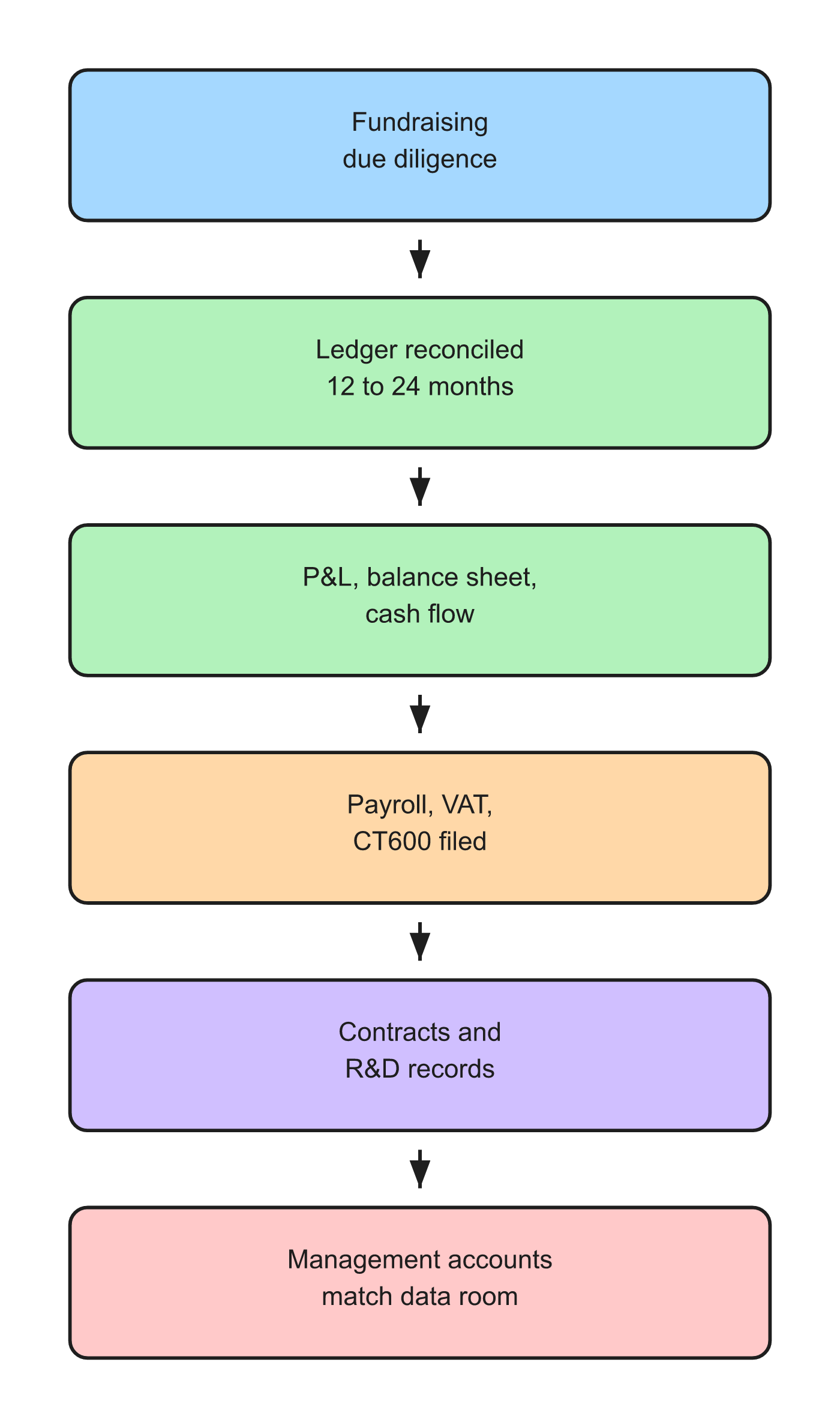
Due diligence preparation flow
SYSTEM INSIGHT / NEXT STEP
Make the next move with clarity.
If this issue is already showing up in reporting, runway, or team decisions, the next move is usually clearer with a structured finance view.
15-point fundraising financial checklist
Work through this list before you open a round, not after term sheet interest.
Books and reporting
Bank and card accounts reconciled for the last 12 to 24 months
Chart of accounts stable (no monthly category reinvention)
Monthly P&L, balance sheet, and cash summary available
Burn and runway documented with the same definition each month
Management accounts match investor updates and board packs
Tax and statutory (UK)
Companies House accounts filed for all periods (no outstanding late filings)
CT600 filed and corporation tax payments on record
VAT returns filed and paid if registered
PAYE and pensions remitted on time (RTI accessible)
R&D claim documentation matches payroll if you claim relief
Contracts and revenue
Material customer contracts filed and revenue recognition consistent with contracts
Deferred revenue (if SaaS) reconciles on the balance sheet
Related-party transactions documented (founder loans, intercompany)
Ownership and governance
Cap table reconciled to Companies House share register and option pool records
Board minutes and written resolutions for funding rounds and material grants
What investors request first
Typical seed diligence list:
Monthly financials (12 to 24 months)
Current year budget vs actual
Bank statements or read-only access
Cap table and option scheme summary
Status of tax filings and any HMRC correspondence
Series A lists add cohort analyses, revenue breakdowns, and audit preparation questions.
Red flags that slow or kill deals
Unexplained adjustments between management accounts and "investor versions" of the P&L.
Personal expenses in the company ledger without clear treatment.
Missing VAT or PAYE filings discovered mid-process.
Cap table does not tie to EMI or ASA agreements.
Founder unable to explain a 20% revenue variance without opening Xero.
How long cleanup takes
Starting state | Typical timeline |
Clean monthly close already | 1 to 2 weeks to assemble data room |
3 to 6 months behind on categorisation | 4 to 8 weeks clean-up project |
Mixed personal/company spend | 8 to 12 weeks plus policy setup |
Use the bookkeeping clean-up checklist if you are starting from backlog.
In practice
Run this checklist against 12 investor-ready signals. Signals are what VCs look for; this list is what you prepare.
A finance partner assembles the data room from live books so founders answer product and market questions during the raise, not chase PDFs.
FAQs
What financial documents do startups need for due diligence?
Monthly P&L and balance sheet, cash proof, cap table, tax filing status, payroll summaries, and key customer contracts.
How far back do investors look at startup financials?
Often 12 to 24 months at seed, longer at Series A.
Can we fundraise with messy books?
Some rounds still close, but terms and speed suffer. Clean books reduce re-trading risk.
What is the difference between a data room and management accounts?
Management accounts are internal monthly reports. The data room is the curated diligence folder investors review.
Should we use a virtual data room?
For institutional rounds, yes. Even for angels, a single organised folder beats scattered email attachments.
**Opening a round in the next quarter?** Talk to an Expert or see pricing.


