
Making Tax Digital for Income Tax: who is affected and when
If you file Self Assessment and earn from a side consultancy, freelance work, or UK property, HMRC's Making Tax Digital for Income Tax (MTD ITSA) rules may apply to you before they apply to your limited company. From 6 April 2026, many individuals must keep digital records and send quarterly updates, not just complete an annual return in January.
That matters for founders who are directors of a startup but also receive personal trading or property income. Your company's accounts and your personal MTD obligations are separate systems.
What is Making Tax Digital for Income Tax?
Making Tax Digital for Income Tax is HMRC's requirement for eligible Self Assessment taxpayers to keep digital records of self-employment and UK property income, submit quarterly updates through compatible software, and file a final declaration with tax due by 31 January.
It replaces the old pattern of recording everything in spreadsheets all year and filing once. HMRC receives income and expense summaries during the year, then a final position after the tax year ends.
SYSTEM INSIGHT / NEXT STEP
Make the next move with clarity.
If this issue is already showing up in reporting, runway, or team decisions, the next move is usually clearer with a structured finance view.
Who must use Making Tax Digital for Income Tax?
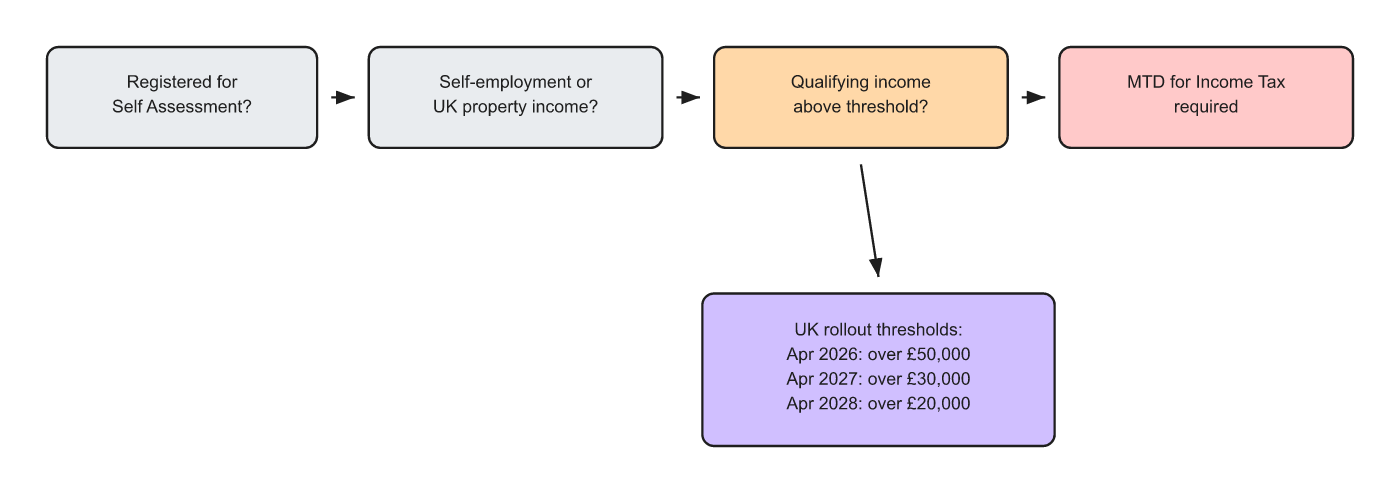
You must use MTD for Income Tax when all of the following apply:
You are registered for Self Assessment.
You receive income from self-employment, UK property, or both.
Your qualifying income is above the threshold for your start date.
MTD for Income Tax eligibility at a glance
What counts as qualifying income?
Qualifying income is broadly your total gross income from self-employment and UK property in the tax year, before most expenses. It is not the same as taxable profit.
A founder with £42,000 in consultancy income and £12,000 in gross rent can be over the £50,000 threshold even after allowable costs reduce taxable profit. HMRC publishes a dedicated guide to work out qualifying income; use it rather than guessing from your bank balance.
When do the thresholds apply?
HMRC's current phased rollout (check GOV.UK for updates):
Start date | Qualifying income threshold |
6 April 2026 | More than £50,000 |
6 April 2027 | More than £30,000 (planned) |
6 April 2028 | More than £20,000 (planned) |
If you are near a threshold, model the next two tax years now. Waiting until your accountant emails in March is how quarterly reporting becomes a crisis.
Does MTD apply to my limited company?
No. MTD for Income Tax applies to individuals in Self Assessment with relevant personal income.
Your startup's corporation tax, VAT, and payroll sit in the company compliance world. A founder can be MTD-compliant personally while the company runs on Xero with a finance partner handling company books. The gap appears when founders assume one accountant filing company accounts covers personal property or consultancy income. It does not.
What founders with side income should check now
Separate personal and company money flows. MTD digital records for property or self-employment need clean feeds. Rent into a personal account, consultancy invoices in your name, and company revenue in the Ltd account.
Confirm software handles your income types. MTD-compatible products vary in support for property vs trade income. Verify against HMRC's software list before you buy.
Calendar quarterly submissions. Four quarterly updates plus a final declaration. Treat dates like Companies House deadlines: fixed, not optional.
Speak to your agent early. If an accountant files Self Assessment for you, they need MTD-capable software and authorisation in place before April 2026.
In practice
UK bank and software publishers explain MTD for sole traders and landlords. Few address the founder edge case: running a venture-backed company while holding personal trading or property income subject to MTD. US startup finance blogs cover bookkeeping but rarely UK MTD ITSA eligibility, thresholds, or quarterly filing mechanics.
MTD is an operating rhythm, not a software purchase. Digital records, categorisation rules, and quarterly tasks should be built into how you already run personal and business finances, not bolted on each January.
FAQs
Who is affected by Making Tax Digital for Income Tax first?
From 6 April 2026, Self Assessment taxpayers with more than £50,000 in qualifying income from self-employment and/or UK property must use MTD for Income Tax.
Is Making Tax Digital for Income Tax the same as MTD for VAT?
No. MTD for VAT applies to VAT-registered businesses. MTD for Income Tax applies to eligible individuals with self-employment or property income in Self Assessment.
Do I need MTD if I only have a salary from my startup?
Generally no, if your only income is employment taxed through PAYE and you have no relevant self-employment or property income. If you also invoice as a sole trader or receive rent personally, test qualifying income.
What if my qualifying income drops below the threshold later?
Rules can change when income falls. Monitor HMRC guidance and speak to your adviser if your income profile changes mid-rollout.
What happens if I miss a quarterly update?
HMRC can charge penalties for late or missed submissions. Build quarterly dates into your compliance calendar the same way you track company filing deadlines.
**Unsure if MTD applies to you from April 2026?** Talk to an Expert. We will map your personal and company income streams and set up a quarterly compliance calendar that fits how you operate.


