
Making Tax Digital for landlords: quarterly submissions explained
From 6 April 2026, many UK landlords must stop treating tax as a once-a-year scramble. If your combined income from self-employment and UK property exceeds £50,000 in a tax year, HMRC expects you to keep digital records and send quarterly updates under Making Tax Digital for Income Tax (MTD ITSA), not just file a Self Assessment return in January.
That shift catches founders who let a flat, run a side consultancy, or hold property alongside a startup role. The rules are procedural, the deadlines are fixed, and the penalty regime does not care that you were busy closing a funding round.
What is Making Tax Digital for landlords?
Making Tax Digital for Income Tax is HMRC's requirement to keep digital business records and submit quarterly income and expense summaries through compatible software, followed by a final declaration and tax payment.
It applies to individuals registered for Self Assessment who earn qualifying income from self-employment, UK property, or both. For landlords, that means rental income, allowable expenses, and the supporting records must live in software that can talk to HMRC, not in a folder of PDFs you reconcile every April.
HMRC's own guidance separates the year into five reporting moments: four quarterly updates and one final declaration, with tax due by 31 January after the tax year ends.
MTD reporting flow for landlords
Here is how the five reporting moments fit together across a standard tax year.
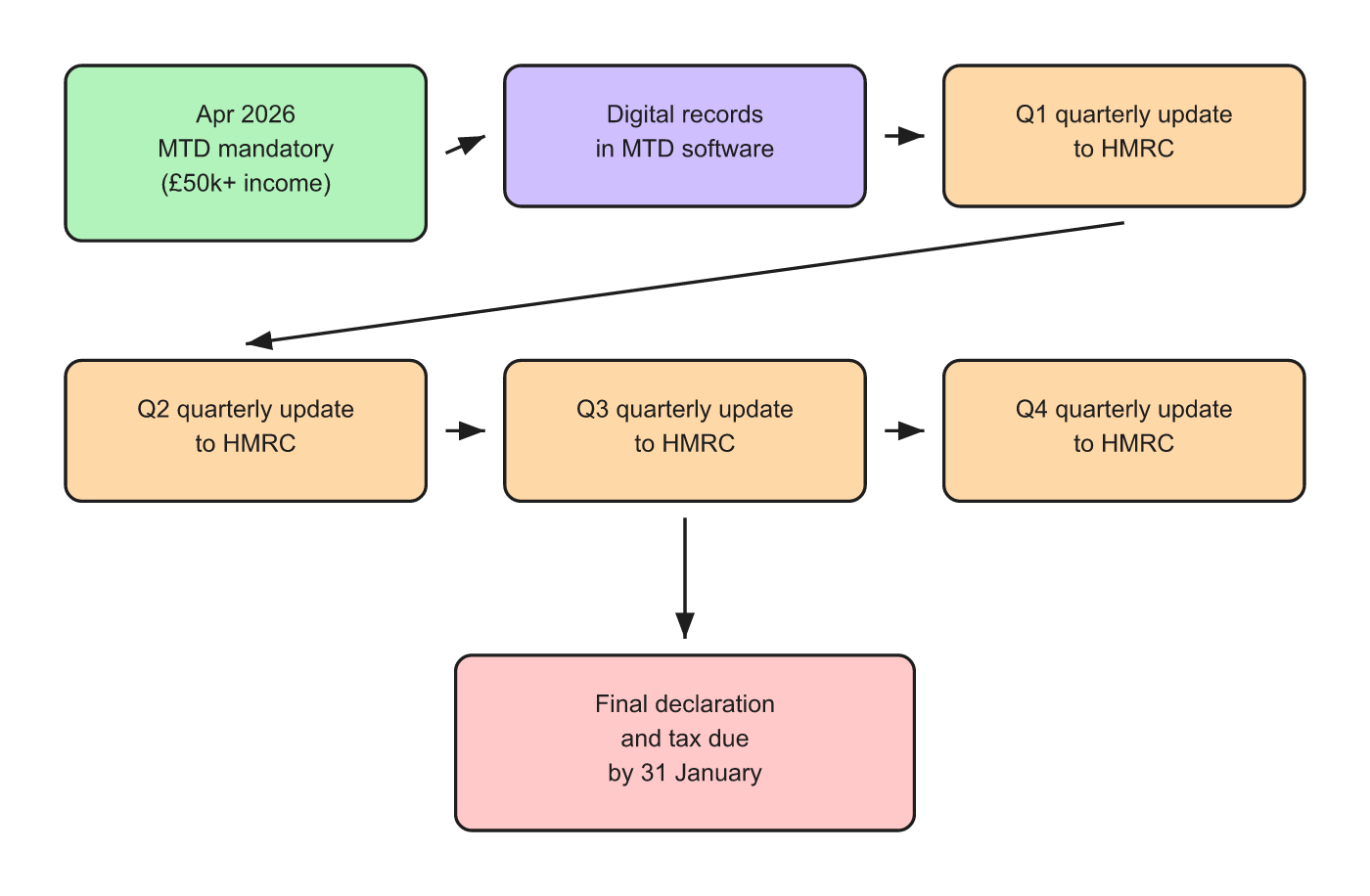
The flow shows four quarterly updates through compatible software, then a final declaration with tax due by 31 January.
Who must use MTD for landlords from April 2026?
You need to follow MTD for Income Tax from 6 April 2026 if all of the following apply:
You are registered for Self Assessment.
You receive income from self-employment, UK property, or both.
Your qualifying income is more than £50,000 in the tax year.
Qualifying income is not the same as profit. HMRC counts gross income from your trades and property before expenses in most cases, so a landlord with £45,000 in rent and £8,000 from consulting can be over the threshold even after mortgage interest and costs are deducted for tax purposes.
Lower thresholds follow in later years (£30,000 from April 2027, then £20,000 from April 2028, per current HMRC plans). If you are near a threshold, model the next two tax years now, not in March 2027.
SYSTEM INSIGHT / NEXT STEP
Make the next move with clarity.
If this issue is already showing up in reporting, runway, or team decisions, the next move is usually clearer with a structured finance view.
What counts as a quarterly submission?
A quarterly update is not a full tax return. It is a summary of income and allowable expenses for each three-month period, sent through MTD-compatible software.
Across a standard tax year you will typically submit:
Quarter 1 (6 April to 5 July)
Quarter 2 (6 July to 5 October)
Quarter 3 (6 October to 5 January)
Quarter 4 (6 January to 5 April)
After the fourth quarter you complete a final declaration that finalises your position for the year. Any tax owed is still due by 31 January following the tax year end (the familiar Self Assessment payment date).
Submission | What you report | What it is not |
Quarterly update | Income and expenses for the quarter | Full tax calculation |
Final declaration | Year-end position and tax due | A replacement for keeping proper books |
What records do landlords need to keep?
HMRC expects digital records created and stored in compatible software. For a typical UK rental portfolio that usually means:
Rent received (per property, per period)
Allowable expenses: repairs, agent fees, insurance, professional fees
Mortgage interest (reported under the current residential property rules)
Capital items vs revenue repairs (misclassification triggers rework later)
Paper receipts can still exist, but the system of record must be digital. Spreadsheets alone do not meet the requirement unless they feed approved bridging software.
If you also run a startup consultancy or freelance work, each income source may need separate digital records within the same MTD journey. That is where founders with a company and personal property income often underestimate the admin load.
Common landlord mistakes before MTD goes live
Waiting until March to categorise a full year of transactions. Quarterly reporting punishes catch-up bookkeeping. A 30-minute monthly review beats a three-day April panic.
Mixing personal and rental bank feeds. One account for rent in, one for property costs out. Your bookkeeper (or future you) will thank you.
Assuming your limited company accounts cover personal rental income. MTD ITSA is personal Self Assessment territory. Your startup's Xero file does not file your landlord quarters.
Choosing software that is "MTD-ready" in marketing only. Use HMRC's compatible software list and confirm it handles property income, not just sole-trader trade income.
In practice
Most MTD content online is written for sole traders or generic small businesses. Landlords who are also founders need one coherent finance rhythm: company books, payroll, VAT if applicable, and personal property reporting, without three disconnected systems.
US startup finance blogs such as Pilot, Kruze, and Mercury publish strong bookkeeping content but rarely cover UK landlord MTD, HMRC quarterly updates, or property income thresholds. UK founders with rental income need guidance tied to HMRC's rules, not US tax forms.
Treat MTD as a monthly compliance system: digital records, categorisation rules, and a calendar of quarterly tasks so updates are a by-product of clean books, not a separate fire drill.
FAQs
When do landlords have to start MTD?
Landlords must use Making Tax Digital for Income Tax from 6 April 2026 if qualifying income from self-employment and UK property exceeds £50,000 in the tax year.
How many MTD submissions do landlords make each year?
Most landlords make four quarterly updates plus a final declaration. Tax is due by 31 January after the tax year ends.
Is MTD the same as filing a Self Assessment return?
No. Quarterly updates report periodic income and expenses. The final declaration replaces the traditional annual return for MTD taxpayers, but you still settle tax by the January deadline.
Can I use spreadsheets for MTD as a landlord?
Not on their own. HMRC requires digital records in compatible software. Spreadsheets may support your process, but submissions must go through approved MTD software.
What happens if I miss a quarterly update?
HMRC can charge penalties for late or missed submissions. Treat quarterly dates like company filing deadlines: fixed, non-negotiable, and cheaper to prevent than fix.
**Need MTD set up before April 2026?** Talk to an Expert. We will map your property and self-employment income, choose compatible software, and build a quarterly calendar that fits how you already run your business.


