
Outsourced bookkeeping for UK startups: when it pays off
Most founders do not decide to outsource bookkeeping because they dislike spreadsheets. They outsource because the books are three weeks behind, payroll does not match the bank, and someone just asked for a management accounts pack for next Tuesday.
At that point, bookkeeping is no longer admin. It is a bottleneck on fundraising, hiring, and board confidence. The real question is whether your startup has reached the point where professional books cost less than the mistakes they prevent.
What is outsourced bookkeeping?
Outsourced bookkeeping means a specialist team records, categorises, and reconciles your transactions in your accounting software on an ongoing basis, instead of a founder or junior hire doing it ad hoc.
A proper provider does more than data entry. They maintain your chart of accounts, reconcile bank and card feeds, flag duplicates, prepare month-end journals, and keep records tidy enough for VAT, CT600, and investor reporting. For UK startups, that also means respecting Companies House timelines, PAYE rhythms, and the gap between company books and personal Self Assessment where directors have other income.
US finance blogs often describe outsourcing as "handing off QuickBooks." For UK founders, the better frame is a finance operating rhythm: weekly categorisation, monthly close, quarterly management view.
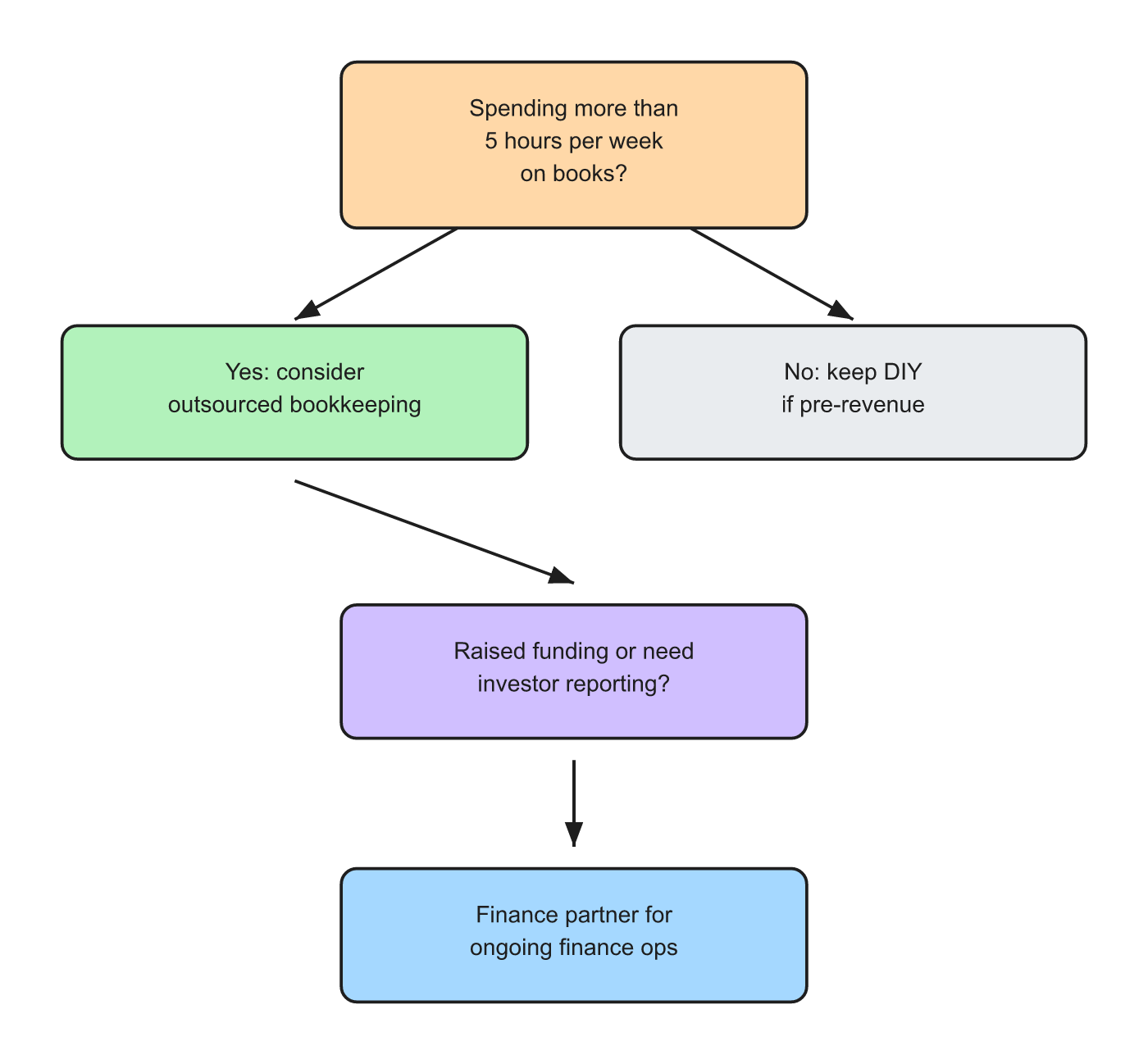
When to outsource: decision flow for UK founders
SYSTEM INSIGHT / NEXT STEP
Make the next move with clarity.
If this issue is already showing up in reporting, runway, or team decisions, the next move is usually clearer with a structured finance view.
When should a UK startup outsource bookkeeping?
Outsource when any of these become true:
Signal | Why it matters |
You spend 5+ hours a week on transactions | Founder time is better spent on product and revenue |
You have raised seed or pre-seed funding | Investors expect timely, categorised numbers |
You need management accounts or board packs | DIY books rarely support monthly reporting |
You are 6+ weeks behind on reconciliation | Catch-up cost rises fast (see below) |
VAT registration is approaching or active | Filing errors trigger penalties and rework |
You are hiring employee #5+ | Payroll, expenses, and benefits add complexity |
VC-backed startup guides often frame this as a stage decision: pre-revenue founders can sometimes DIY with discipline; post-raise companies need a system before diligence asks awkward questions. The trade-off is usually cost and loss of direct control against accuracy and time returned. US pillar guides cover services to outsource, process steps, and pricing bands, but they are US-tax centric.
Headcount alone is not the trigger. Outsource when financial visibility affects a decision you are about to make: a round, a hire, a VAT registration, or a term sheet.
What should you outsource first?
Not every finance function moves at once. A sensible order for UK startups:
Transaction recording and bank reconciliation (the foundation)
Payroll coordination with your accounting file
VAT returns (if registered)
Management accounts (P&L, balance sheet, cash view)
Year-end accounts and CT600 (statutory layer)
Typical outsourcing guides list categorisation, reconciliations, accounts payable and receivable, and reporting. Some add bill pay and expense policies. Month-end close checklists and automation before close matter just as much for UK clients.
Outsource catch-up bookkeeping separately if you are already behind. A standard catch-up playbook runs six steps: gather data, categorise, reconcile, report, tax prep, stay current. That is almost always a distinct project fee before ongoing monthly work.
What does outsourced bookkeeping cost in the UK?
Pricing varies by volume, complexity, and whether you need reporting beyond compliance.
Stage | Typical monthly range (indicative) | What drives cost |
Pre-revenue / low transaction | £200 to £400 | Few feeds, simple chart of accounts |
Seed, 10 to 30 employees | £400 to £900 | Payroll, expenses, investor reporting |
Post-Series A | £900+ | Multi-entity, VAT, management accounts, board packs |
Treat sub-£150 "bookkeeping" offers sceptically if you have investors, staff, or VAT. Someone pays for the gap later through corrections, catch-up fees, or a failed diligence request.
How to choose a UK bookkeeping partner (not just a freelancer)
Questions worth asking before you sign:
Do you work with UK startups, not just small businesses?
Is reporting monthly, not only year-end?
Who owns VAT, PAYE, and Companies House coordination?
Can you produce management accounts without a separate project each time?
What is your catch-up process if we are behind today?
Is support human-backed, or only a shared inbox and a portal?
In practice
US outsourcing guides centre US tax forms, US pricing, and vendor comparisons. Banking-led content teams cover generic startup ops. VC-backed SaaS playbooks focus on US founders. UK/EU founders from pre-seed to Series A need HMRC, Companies House, MTD, VAT, and CT600 in one rhythm, with founder-specific triggers on a UK compliance calendar.
The question to answer is simple: if you outsource, what actually changes in your month, and what do investors see?
That usually means a named finance contact rather than a ticket queue, books that support fundraising and board conversations without a rebuild, and compliance handled as a system where deadlines are tracked, not remembered.
FAQs
Is outsourced bookkeeping worth it for pre-revenue startups?
If you are pre-revenue with fewer than 20 transactions a month, disciplined DIY can work short term. Once you raise, hire, or register for VAT, the cost of errors usually exceeds outsourcing.
What is the difference between bookkeeping and accounting?
Bookkeeping is recording and reconciling transactions. Accounting adds reporting, tax filings, and judgement: year-end accounts, CT600, VAT returns, management accounts. Many UK startups need both, bundled.
When should I stop DIY bookkeeping?
Stop when you are behind on reconciliation, spending several hours a week on admin, or anyone external (investor, lender, acquirer) asks for numbers you cannot produce within a few days.
Can outsourced bookkeeping help with fundraising?
Yes. Clean, categorised, reconciled books shorten diligence and improve credibility in data rooms. Messy books delay rounds and sometimes kill them.
How long does catch-up bookkeeping take?
Depends how far behind you are. A few months of neglected feeds can take 1 to 3 weeks of focused work before ongoing monthly bookkeeping stabilises.
**Books behind, or about to raise?** Talk to an Expert for a 15-minute review of where your finance operations stand and what outsourced support should look like at your stage.


