
Outsourced finance team for startups: build vs buy decision
At twelve employees you probably do not need a five-person finance department. At forty, one bookkeeper may not be enough. The question is when to hire in-house, when to outsource, and what "finance team" should mean at your stage.
For UK startups, finance ops includes bookkeeping, VAT, PAYE, CT600, Companies House, and investor reporting. Build vs buy is really about coverage of that full stack, not just who clicks approve in Xero.
What is an outsourced finance team?
An outsourced finance team is a external partner that runs part or all of your finance function: transaction recording, month-end close, management accounts, payroll coordination, VAT, and statutory filings.
It is broader than outsourced bookkeeping alone. Bookkeeping is the foundation. A finance team layer adds reporting rhythm, compliance ownership, and board-ready packs.
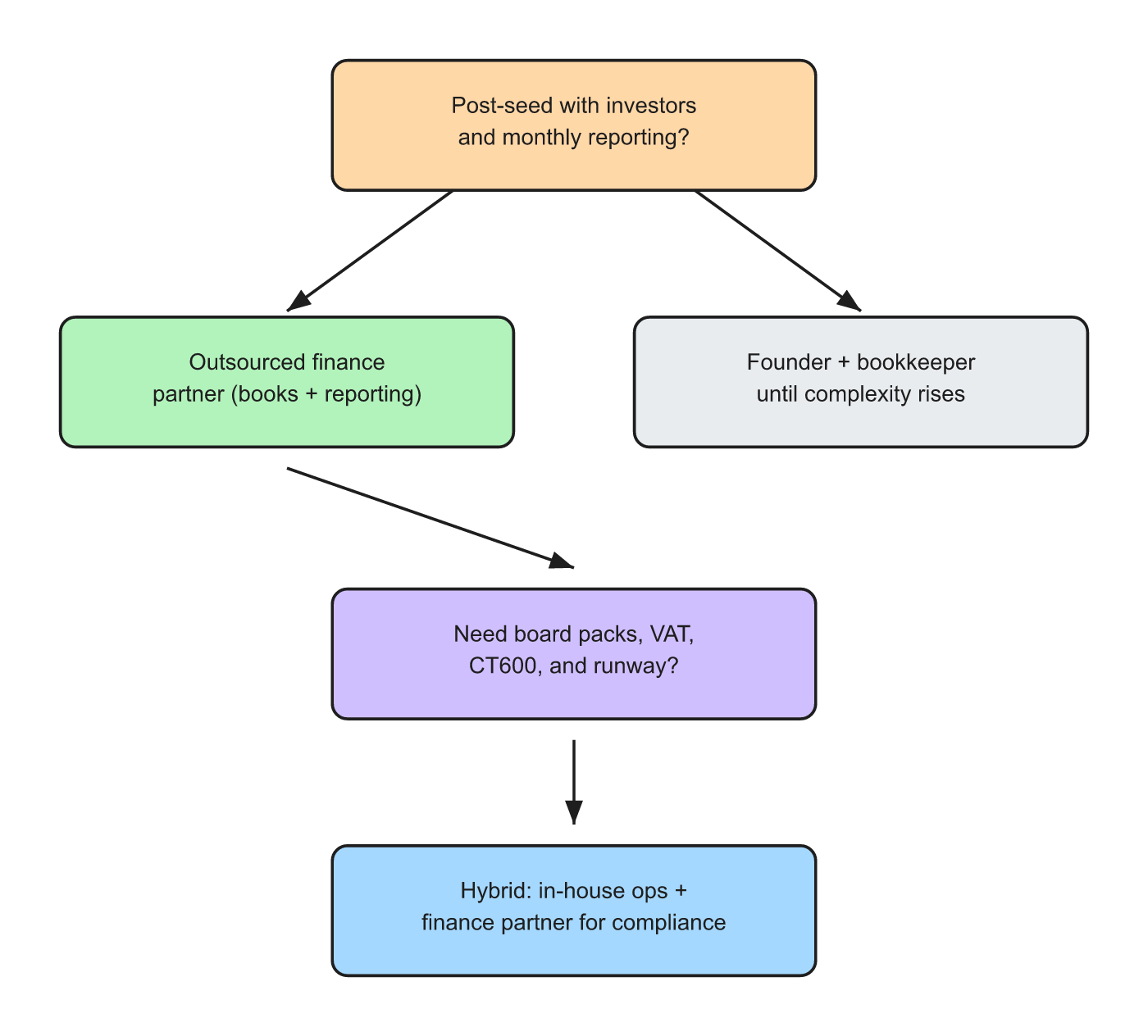
Build vs buy decision flow
SYSTEM INSIGHT / NEXT STEP
Make the next move with clarity.
If this issue is already showing up in reporting, runway, or team decisions, the next move is usually clearer with a structured finance view.
Option 1: Founder plus DIY (pre-seed)
Works when transaction volume is low, there are no employees, and investors are not asking for monthly packs.
Breaks when: you hire, register for VAT, raise seed, or spend more than a few hours a week on books.
Cost: founder time (often underestimated) plus software (~£30 to £80 per month).
Option 2: In-house bookkeeper or finance manager
A part-time or full-time hire owns day-to-day processing and may coordinate with an external accountant for year-end.
Pros: sits in Slack, knows the business deeply, can support ops hires and expenses.
Cons: single point of failure, holiday cover, and you still need external expertise for tax, R&D claims, or complex group structures. UK compliance breadth is hard for one generalist at seed stage.
Indicative cost: £35k to £55k full-time equivalent in London, plus employer NICs and software.
Option 3: Outsourced finance partner
A partner team provides bookkeeping, close, management accounts, VAT, and coordination with auditors or tax advisers.
Pros: coverage across UK compliance, faster recovery from backlog, no recruiting cycle, often cheaper than a full-time hire until Series A scale.
Cons: less embedded than a desk in your office (mitigated by a named contact and regular cadence).
Indicative cost: often £400 to £900+ per month post-seed, depending on volume (see ranges in outsourced bookkeeping).
Option 4: Hybrid (common from seed to Series A)
Founder or ops lead owns expenses and approvals. Outsourced partner owns ledger, close, compliance calendar, and investor packs. External tax adviser handles R&D or complex planning.
This is where many UK VC-backed startups land until roughly 30 to 50 employees.
When to hire a full-time finance lead
Signals you may need in-house leadership:
Multiple entities or currencies
Audit or Series B diligence requiring a dedicated controller
Finance headcount managing AP, AR, and treasury daily
Regulatory reporting beyond standard UK Ltd compliance
Until then, a fractional CFO plus outsourced ops often beats a premature full-time CFO hire.
Build vs buy comparison
Factor | In-house hire | Outsourced finance team |
Time to start | 2 to 4 months hiring | Days to weeks onboarding |
UK compliance breadth | Depends on hire's experience | Usually bundled |
Investor reporting | You design the process | Often included monthly |
Cost at seed | Higher fixed salary | Variable monthly fee |
Cover for absence | You manage | Partner team backup |
Decision triggers (UK startups)
Outsource or hybrid when:
You raised seed and investors expect monthly reporting
VAT registration is live or imminent
Payroll runs monthly with benefits and pensions
Founders spend more than five hours a week on finance admin
You missed a compliance deadline once already
Build in-house leadership when:
Finance is a daily product of the business (fintech, lending)
Headcount and entity complexity outgrow a single outsourced pod
Board requests a dedicated CFO or controller on the org chart
In practice
The build vs buy decision is not permanent. Most startups outsource through seed, add a fractional CFO for fundraise or board cycles, then hire in-house when volume and risk justify a full salary.
The failure mode is hiring too early (expensive, underutilised) or DIY too long (missed VAT, messy diligence, founder burnout).
FAQs
What is the difference between outsourced bookkeeping and an outsourced finance team?
Bookkeeping focuses on transactions and reconciliations. A finance team adds month-end close, management accounts, compliance ownership, and investor reporting rhythm.
When should a UK startup outsource finance?
Often at or soon after seed, when payroll, VAT, and monthly investor reporting appear together.
Is outsourcing finance cheaper than hiring?
Usually at seed and Series A stage, yes, compared with a full-time finance manager plus external accountants for tax and filings.
Can we switch from outsourced to in-house later?
Yes. Clean books and documented processes make handover easier. Messy books make any transition expensive.
Do investors care if finance is outsourced?
Investors care that numbers are accurate, timely, and consistent. Outsourcing is normal at seed stage if reporting quality is high.
**Comparing build vs buy for your stage?** Talk to an Expert or see pricing.


