
Startup bookkeeping in the UK: what founders should expect after seed
Before seed, bookkeeping is survival mode: keep the company alive, do not mix personal and company money, file what HMRC requires.
After seed, bookkeeping becomes infrastructure. Investors expect clean monthly data. Payroll scales. Board meetings need numbers. Due diligence will replay every month you ignored the books.
What changes after a seed round?
After seed, UK startup bookkeeping shifts from occasional record-keeping to a monthly operating discipline: separated finances, coded transactions, timely close, and reports that match what you tell investors.
You may still do some tasks in-house. The standard of evidence rises sharply.
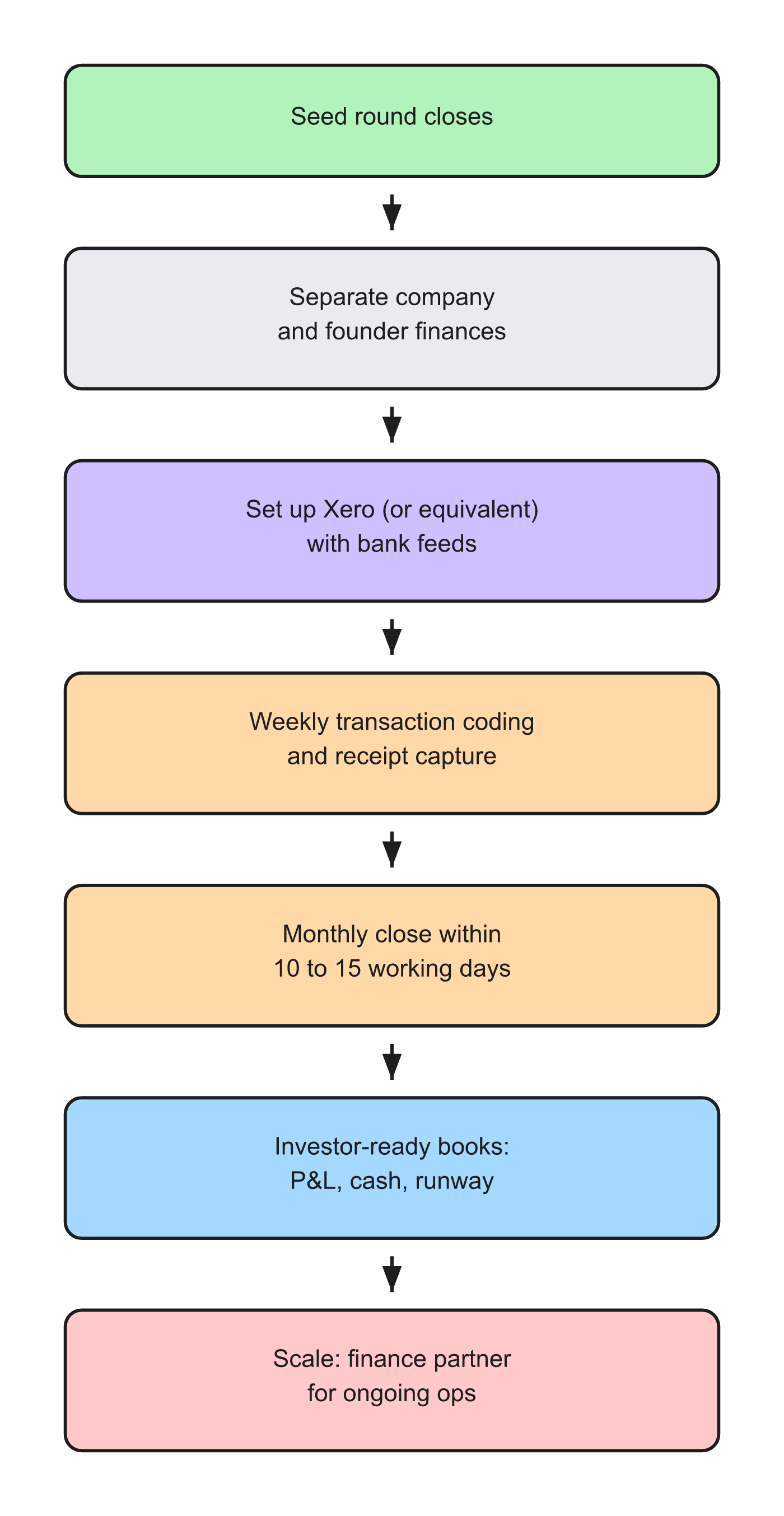
Bookkeeping journey after seed
SYSTEM INSIGHT / NEXT STEP
Make the next move with clarity.
If this issue is already showing up in reporting, runway, or team decisions, the next move is usually clearer with a structured finance view.
1. Separate company and founder finances
This should already be true. After seed, enforce it:
Company revenue and spend flow through Ltd company accounts
Founder salary via PAYE, not ad hoc transfers
Personal expenses reimbursed with receipts, not guessed
Mixed accounts are the fastest way to lose investor trust in diligence.
2. Set up proper accounting software (usually Xero)
For most UK startups, Xero is the practical default:
Capability | Why it matters post-seed |
UK bank feeds | Daily transaction import |
Payroll integration | Scales with first hires |
MTD readiness | VAT and future income tax rules |
Investor reporting exports | Feeds management accounts |
Connect all bank accounts, cards, and payment processors (Stripe, Paddle, etc.) on day one after close.
UK founder communities consistently pick Xero for bank feed reliability and MTD compliance. QuickBooks can work but is less common in UK VC-backed setups.
3. Build a weekly transaction rhythm
Bookkeeping is not only a month-end task. Weekly habits reduce close pain:
Code uncategorised transactions
Chase missing receipts from founders and contractors
Match customer payments to invoices
Flag large or unusual items for review
Once transaction volume grows, bill pay automation and card rules help. At seed stage, discipline matters more than tools.
4. Run a monthly close on a fixed schedule
After seed, adopt a month-end close checklist:
Reconcile cash
Post payroll and accruals
Review P&L and balance sheet
Publish a management accounts pack
Aim to close within 10 to 15 working days of month end. Investors notice when you cannot explain last month's burn.
5. Keep books investor-ready
Post-seed, "good enough" means diligence-ready. VC investors will test whether revenue recognition, burn, and runway match what you have reported month to month.
Area | Investor expectation |
Revenue recognition | Matches contracts/subscriptions |
Burn and runway | Reconciles to bank |
Cap table vs expenses | No personal costs in CAC |
R&D spend | Tagged if you will claim relief |
VAT | Correct treatment if registered |
You do not need audited accounts at seed. You do need consistency month to month.
6. Know when to bring in a finance partner
Stay DIY if pre-revenue and sub-five hours per week on books. After seed, consider outsourced bookkeeping or a finance partner when:
Close slips past 15 working days repeatedly
Payroll, VAT, and reporting compete for founder time
Board or investor updates need monthly packs you cannot produce
You are hiring faster than your chart of accounts can support
In practice
A finance partner can run ongoing ops (bookkeeping, close, management accounts, compliance) so founders stay on product and growth. AccountUp covers that operating layer after seed.
What founders should expect from startup bookkeeping (realistic)
Expectation | Reality |
"Xero does it all" | Xero records data; humans reconcile, adjust, and review |
"We'll fix books before Series A" | Diligence replays 12 to 24 months of history |
"Our accountant handles everything" | Year-end accountants may not run monthly close |
"Bookkeeping is admin" | It is the data layer for runway and fundraising |
FAQs
What is startup bookkeeping in the UK?
Startup bookkeeping is recording, categorising, and reconciling a company's day-to-day financial transactions so accounts are accurate for tax, reporting, and investor diligence.
How much does startup bookkeeping cost in the UK?
Costs vary by volume, headcount, and complexity. Pre-seed DIY is cheapest. Post-seed outsourced support often starts from a few hundred pounds per month and scales with transaction volume and reporting needs.
Should UK startups use Xero or QuickBooks?
Most UK startups use Xero for bank feeds, payroll integrations, and MTD compatibility. QuickBooks can work for smaller or non-VC paths. Pick one system and stay consistent.
When should a startup stop doing its own bookkeeping?
Common triggers: raised seed funding, first employees on payroll, monthly board reporting, or consistently spending more than five hours per week on books.
What is the difference between bookkeeping and accounting for startups?
Bookkeeping is transaction recording and reconciliation. Accounting adds judgement: accruals, tax treatment, year-end filings, and management reporting. After seed, you need both rhythms.
**Just closed seed and need books that scale with you?** Talk to an Expert or see AccountUp pricing.


