
What should be in management accounts? A founder's guide
Boards do not ask for management accounts because they enjoy PDFs. They ask because they need answers: Are we growing? Is cash safe? Did we stick to plan?
Management accounts are the monthly internal report that answers those questions before year-end accounts exist.
What are management accounts?
Management accounts are periodic financial reports (usually monthly) prepared for founders, boards, and operators. They are not filed with Companies House or HMRC.
For UK startups, they sit between daily bookkeeping and statutory year-end accounts. Good management accounts use the same ledger as VAT returns and corporation tax, so numbers do not fork into three versions.
What each section answers for founders
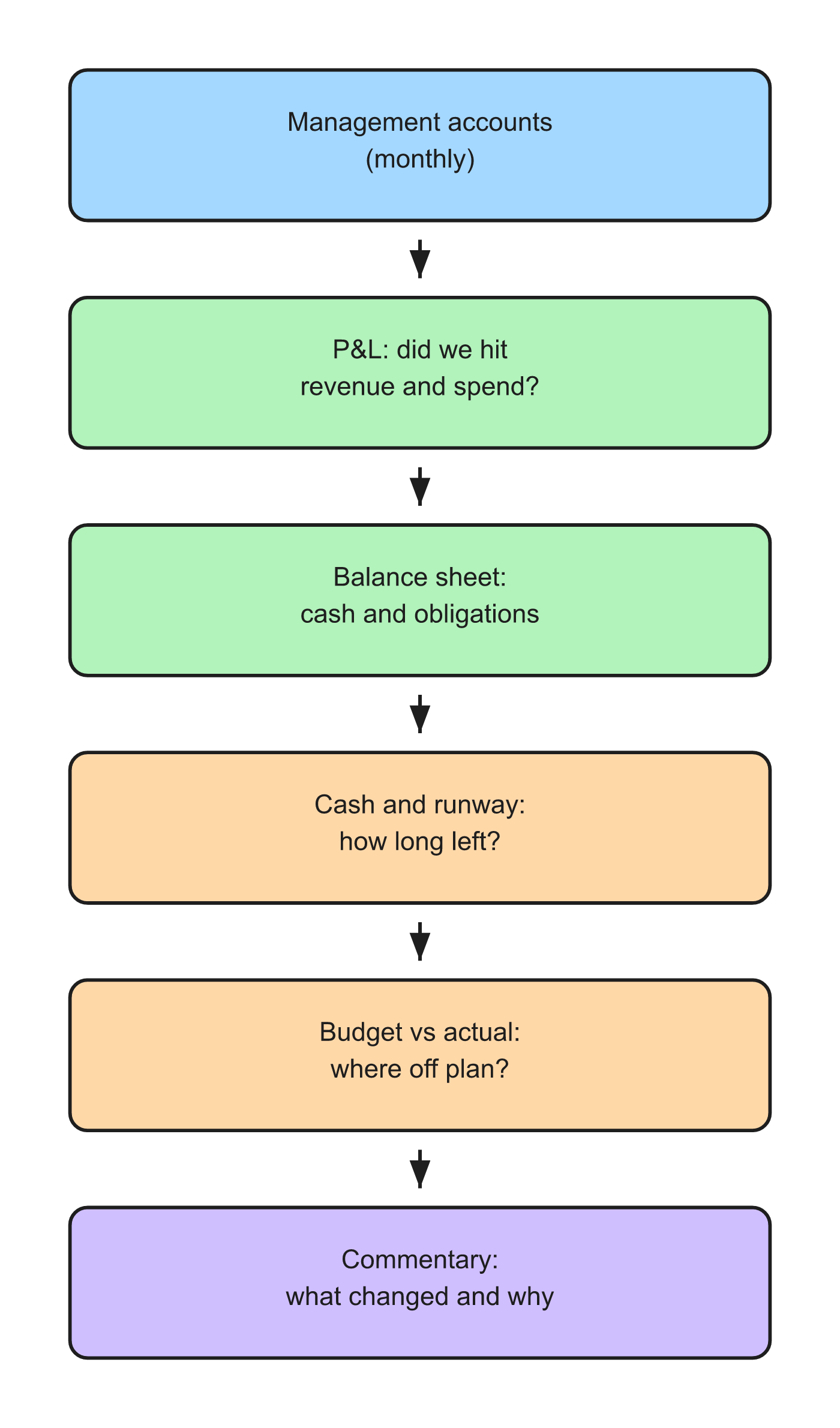
If you want a layout to copy, see the management accounts template for UK startups. This guide explains what belongs in the pack and why.
SYSTEM INSIGHT / NEXT STEP
Make the next move with clarity.
If this issue is already showing up in reporting, runway, or team decisions, the next move is usually clearer with a structured finance view.
1. Profit and loss (month and year to date)
The P&L answers: did revenue and spend move the way we expected this month?
Include:
Revenue (or MRR for SaaS) for the month and year to date
Cost of sales or hosting if you track gross margin
Operating costs by category (people, sales and marketing, R&D, G&A)
EBITDA or net profit if your board uses it
Founders often over-customise categories each month. Lock your chart of accounts and map board-friendly groupings once.
2. Balance sheet snapshot
The balance sheet answers: what do we own and owe right now?
Minimum lines for startups:
Cash and bank balances
Trade debtors and creditors
Deferred revenue (SaaS)
Loans, convertible notes, or other debt
Share capital and retained earnings
You do not need a novel format. You need the same format every month so directors can compare.
3. Cash and runway
The P&L can look healthy while cash falls. This section answers: how long can we run at current burn?
Include:
Opening and closing cash
Major cash movements (fundraise, tax, large capex)
Runway in months at current net burn
Runway is the number boards reach for first when hiring or spending is debated.
4. Budget vs actual
This section answers: where are we off plan, and does it matter?
Compare budget to actual for revenue and the top five to eight cost lines. Add one line of commentary per material variance (typically anything over 10% off plan or anything that moves runway by a month).
Illustrative example for a seed SaaS company:
Line | Budget | Actual | Variance |
Revenue | £42,000 | £38,500 | -8% |
Payroll | £28,000 | £29,200 | +4% |
Sales and marketing | £12,000 | £14,500 | +21% |
Variances without notes are noise. Notes without numbers are opinion.
5. KPI block (stage-appropriate)
Management accounts are not a dashboard product, but a small KPI table belongs here:
Stage | Examples |
Pre-seed / seed | MRR, burn, runway, headcount |
Post-raise | Gross margin, CAC payback, net revenue retention |
Pick metrics your board already expects. Do not paste forty charts.
6. Commentary (half a page maximum)
Commentary answers: what changed, what it means, and what we do next.
Four prompts:
What improved vs last month?
What got worse?
What decision does this inform?
What do we need from the board (if anything)?
This is the internal draft of your investor update narrative.
Minimum viable vs full pack
Situation | Minimum | Full pack |
Pre-revenue, no board | P&L + cash | Add balance sheet when you hire |
Seed with monthly board | P&L, cash, runway, commentary | Add budget vs actual and KPIs |
Series A prep | Full pack monthly | Same data feeds investor reporting and diligence |
Common mistakes
Waiting until year-end to fix categorisation. If payroll and revenue recognition are wrong in July, October's pack is wrong too.
Hiding a bad month. Boards forgive misses. They do not forgive surprises in diligence.
Treating management accounts as personal tax reporting. The pack is for the limited company.
In practice
Management accounts only work if month-end close happens on schedule. Close, pack, review: that is the operating rhythm.
When books are clean, the same numbers power financial reporting for investors without a parallel spreadsheet.
FAQs
What is the difference between management accounts and annual accounts?
Annual accounts are statutory year-end reports for Companies House and corporation tax. Management accounts are internal and usually monthly.
Do small UK companies need management accounts?
There is no legal requirement. Investors and boards expect them once you raise or hire a finance-minded director.
How often should startups prepare management accounts?
Monthly is standard after seed. Some pre-revenue companies move quarterly until transaction volume grows.
What software do UK startups use for management accounts?
Most use Xero (or similar) as the ledger, then export or report packs from the accounting file. The pack is a presentation layer on live books.
Should management accounts include cash flow?
Yes. At minimum show opening cash, closing cash, and runway. A full cash flow statement helps at Series A.
**Need management accounts from live books every month?** Talk to an Expert or see pricing.


